
How to Search Criminal Dockets
Begin with Indiana MyCase, the public entry point for a Warren County criminal docket. The best route is the case number, citation number, or cross-reference number on an official notice. Enter just one value. Prefer a name search instead? Pick Warren County and set the case type to Criminal and Citation. Add a first name, filing range, or status only if it helps. Searches run too broad can bump into the 1,000-result cap or trigger a CAPTCHA. Before opening anything, check the court, case type, filed date, and party role. That way the record truly matches. Then read the chronological case summary, called the CCS, down to the newest entry. One caution: converted older events sometimes lack scanned attachments. A dead document link does not mean the filing never happened.
- Start with the exact case or citation number.
- Otherwise enter a party name and select Warren County.
- Choose Criminal and Citation, then narrow by date.
- Open the summary and compare the charge and court fields.
- Read later entries for amendments, continuances, and disposition.
- Ask the Warren Clerk for an official copy when needed.
Warren Charges Are Not Convictions
A charge row is only an allegation. It may carry an offense date, statute, degree, citation, and both original and filed-as offenses. Prove guilt, it does not. Later entries on the Warren County criminal docket can show amendment, dismissal, plea, verdict, judgment, or sentence. The disposition language controls what the outcome was. Treat bond as its own thing. An amount, type, posting date, or status speaks to release while the case moves ahead, not to punishment. Read the whole sequence before drawing conclusions. A hearing label is not a ruling. A plea entry is not always the sentencing entry. Appellate or expungement activity later on can also change what stays public.
Reading rule: Allegation → hearing → ruling → disposition. Confirm each step from a later Warren docket entry or signed order.
What a Criminal Docket Shows
A Warren County criminal court docket blends identifying fields with a running procedural log. What is public varies with the case code, the case's age, its conversion history, and confidentiality rules. Use the header to confirm you have the right case. The CCS tells you what was filed or ordered. A linked document gives the full text where access rules allow.
| Case header | Number, style, Warren Circuit Court, type, filed date, and status. |
|---|---|
| Charges | Count, alleged offense, statute, degree, offense date, and citation. |
| Bond | Type, amount, status, and dates, not the final result. |
| CCS events | Filings, notices, hearings, motions, orders, and payments. |
| Disposition | Dismissal, plea, verdict, judgment, sentence, or other result. |
| Documents | Nonconfidential orders or filings released for remote access. |
Financial figures online can be stale, so the Clerk can confirm a current balance or issue a certified ledger.
Warren Deferral and Diversion
The Prosecutor offers infraction deferral and pretrial diversion. Details come from the official Warren deferral and diversion explanation. The court is not a party to the contract and does not control the offer. Even so, the agreement is enforced through the court. Meet every condition on an infraction deferral and a civil judgment may be avoided on the driving record. For a defendant without a lawyer, pretrial-diversion talk usually waits until after the initial hearing. The county's official page spells out the details.
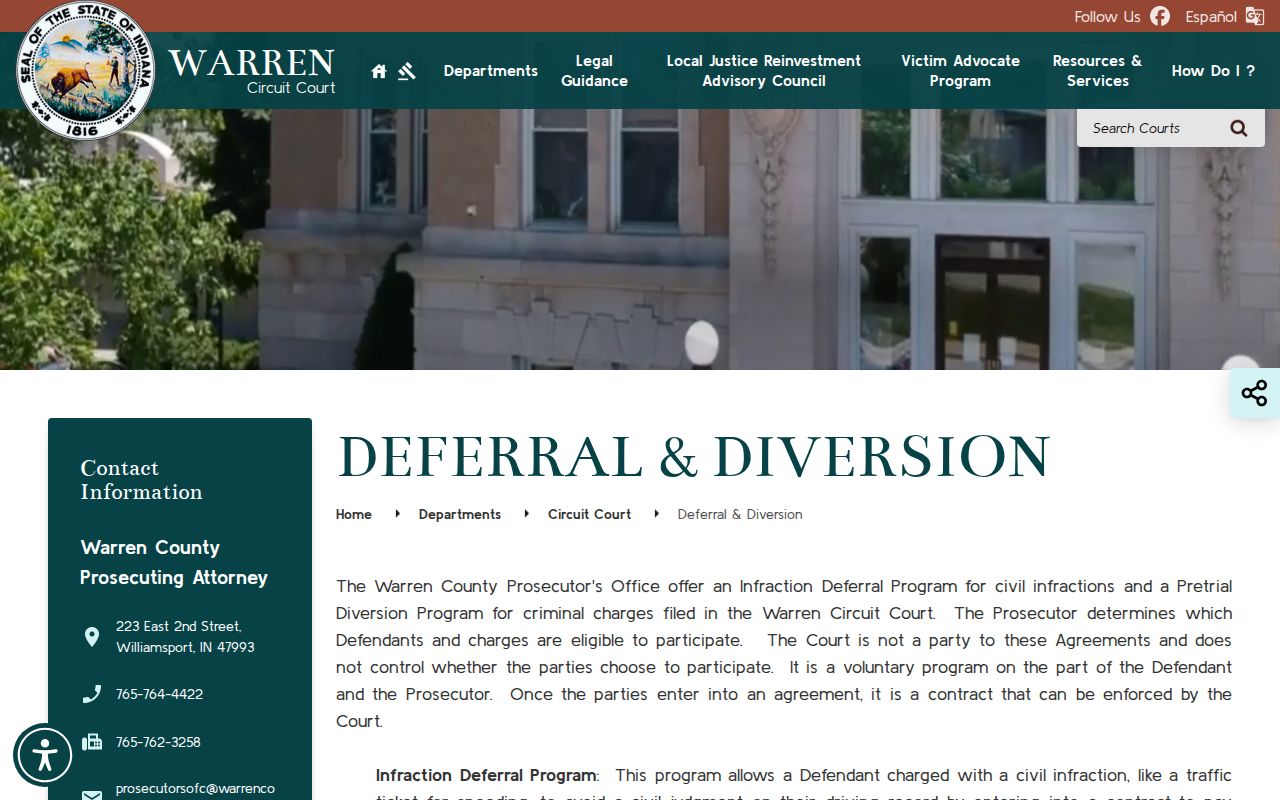
A program label is not a final disposition. Completion, and the court's resulting action, must appear in later docket entries.
Stages on a Criminal Docket
Filing → Arraignment → Pretrial → Plea or Trial → Disposition → Sentencing is a useful outline, but not every Warren criminal case uses every stage. Several settings can occur between them. An initial hearing addresses the accusation and next steps. Pretrial entries can concern discovery, counsel, bond, motions, negotiations, and scheduling.
An event date can differ from the hearing date or from the day an order was signed. A session on the calendar does not prove anyone appeared. See "continued" or "canceled," and you should look for a later setting.
- CCS
- The Chronological Case Summary, a date-ordered procedural record.
- Disposition
- The recorded resolution of a charge or case.
- Continuance
- An order moving an event to a later date.
- Converted event
- An older system entry that may lack an online image.
Bi-County Accountability Court Events
Warren and Fountain counties share a problem-solving program, the Bi-County Accountability Court. Its Drug Court events range from assessment and supervision to review hearings, incentives, sanctions, graduation, or termination. Those events sit inside the underlying criminal case. Clinical, treatment, and supervision details may be restricted, though. The official program page gives context for these specialty entries.
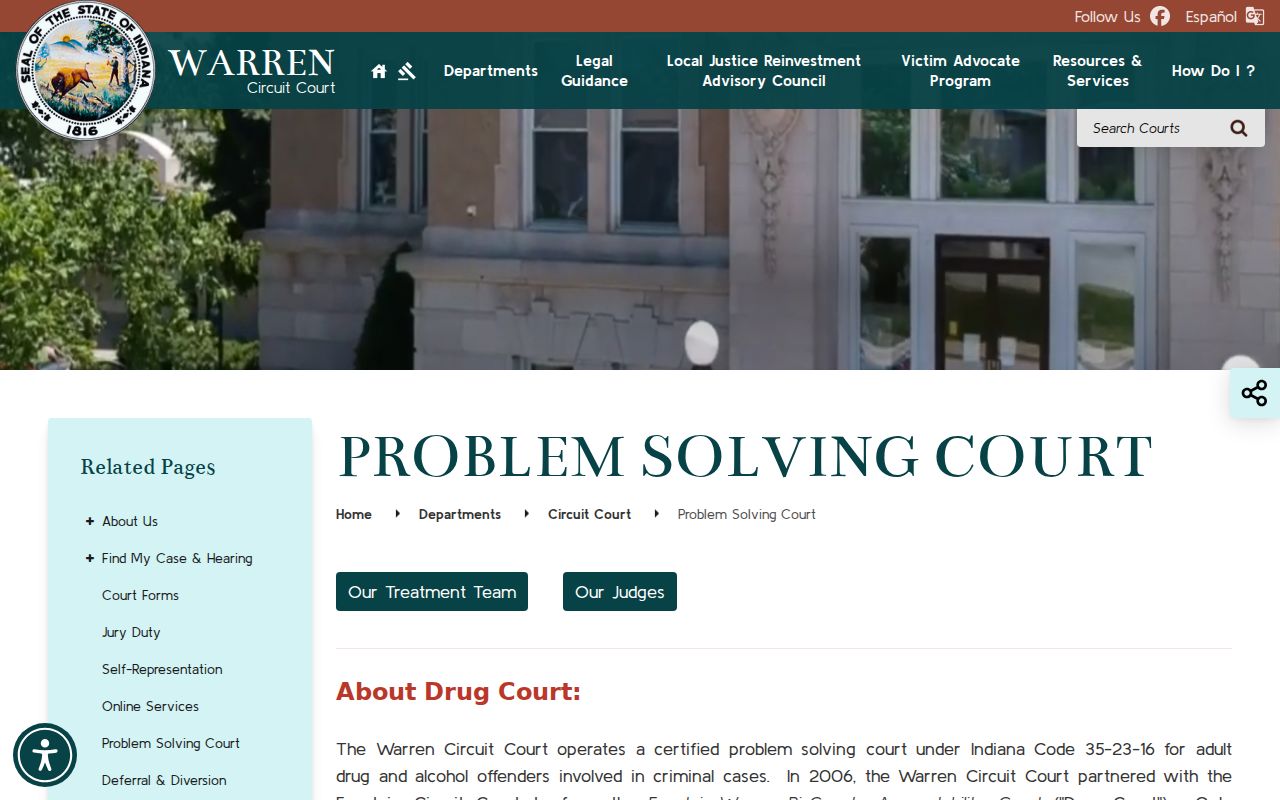
Read a public docket only for the events it records, and make no assumptions about private treatment information.
Which Court Holds Criminal Dockets
One trial court serves the county: Warren Circuit Court. Local Rule LR86-AR00-101 gives its sole judge the whole county caseload. The state directory lists no separate Warren Superior, county, city, or town criminal court. The Warren Clerk keeps the official local case record. A case out of Williamsport, West Lebanon, Pine Village, or State Line City that becomes a county criminal matter is searched under Warren Circuit Court. Police reports stay with the agency. Driving records stay with the BMV. Federal cases stay with the federal clerk.
| Record | Custodian |
|---|---|
| Criminal docket or filed order | Warren Circuit Court and Clerk |
| Police incident report | Investigating agency |
| Driving record | Indiana BMV |
| State criminal history | Indiana State Police |
Missing Warren Docket Attachments
Plenty of criminal case codes expose final orders rather than every pleading. A felony case may show sentencing orders while other filings sit at the Clerk's office. A case header can stay public even when one attachment is redacted, sealed, or excluded. Remote document access varies by case type. For the details, Indiana's MyCase access matrix lays it out.
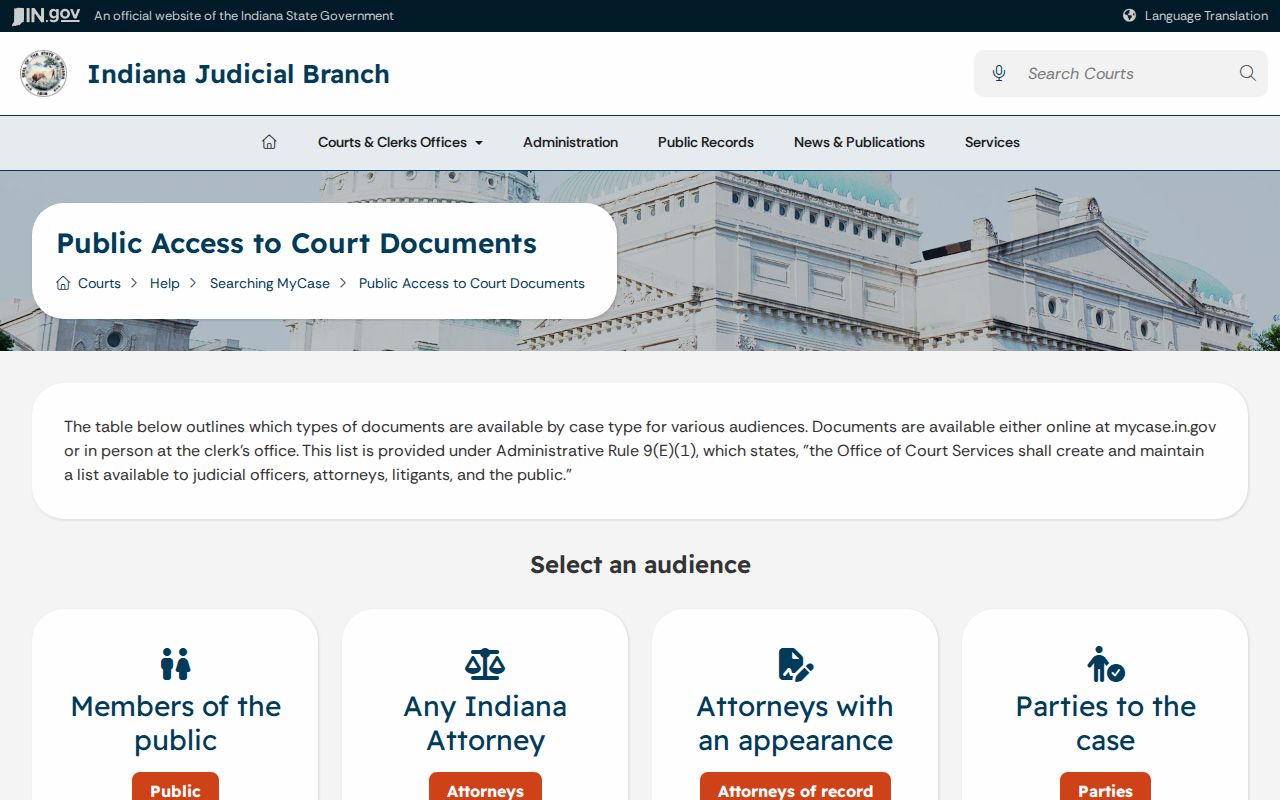
That matrix explains why the case code matters. Note the CCS date and description first, then ask the Clerk whether a public copy exists.
Warren Docket Versus Other Records
A Warren County criminal docket answers a narrow set of questions. When was the case filed? Which counts were alleged, and which counsel appeared? It lists the hearings that were set, the motions and orders entered, and the disposition the court recorded. It does not carry the paper behind each line. A CCS entry might note that an order issued yet leave out its full terms. The Warren Clerk decides whether the public may inspect, copy, or certify that document.
The docket also cannot replace records kept outside the courts. An incident report belongs to the law-enforcement agency that wrote it. A jail record tracks custody, nothing else. The Indiana BMV keeps driver records. The Indiana State Police offers its own criminal-history products. Each source follows different dates, labels, and legal rules. Merge them as though they formed one Warren court record, and you may build a false picture of the case.
Following a public case of local interest takes care. Note the case number, court, case type, CCS date, entry description, and source date. Then separate direct facts in an order from mere allegations in a charge or motion. A party's filing states that party's view. It is not a ruling. A calendar setting, too, shows planned court activity rather than what actually happened. That discipline keeps a Warren criminal docket search anchored to what the official court record truly says.
| Source | Question it answers | Important limit |
|---|---|---|
| MyCase summary | What public case events are recorded? | Not certified and not every document is linked. |
| Warren Clerk copy | What does the filed public document say? | Access, redaction, and copy rules still apply. |
| Court Calendar | When is a public hearing scheduled? | A setting can move and is not an outcome. |
| Agency or BMV record | What does that separate custodian maintain? | It is not part of the court's docket. |
Need a transcript or audio record rather than a docket entry? First find the hearing date. Then ask the court reporter about the request process. A transcript captures the spoken proceedings, while a docket merely summarizes procedural activity, so never infer one from the other.
Public Access and Sealed Criminal Dockets
Indiana's Rules on Access to Court Records start from public access yet protect safety, privacy, privilege, and confidential records. Remote MyCase access is narrower than courthouse access. Juvenile, mental-health, medical, treatment, pretrial-supervision, sealed, and protected-personal-information records may be withheld or limited.
A missing Warren criminal docket result has several causes. Confidentiality, expungement, an unconverted older record, or a system problem can all explain it. It is not proof no case exists. Protection orders use a separate search. A granted expungement also differs from a pending or denied request.
Indiana access rules:
Access Rule 4 sets the general presumption of access.
Access Rule 5 identifies excluded cases, records, and data.
Administrative Rule 9 distinguishes remote, courthouse, bulk, and special access.
For an official record, give the Clerk the case number and the exact CCS event. Then name the service: inspection, an ordinary copy, or certification.